To evaluate an exponential function with the form f(x)=bx,we simply substitute x with the given value, and calculate the resulting power. For example: Let f(x)=2x.
Is radioactive decay an application of exponential function?
Now k is a negative constant that determines the rate of decay. We may use the exponential decay model when we are calculating half-life, or the time it takes for a substance to exponentially decay to half of its original quantity. We use half-life in applications involving radioactive isotopes.
How do you know if exponential growth or decay?
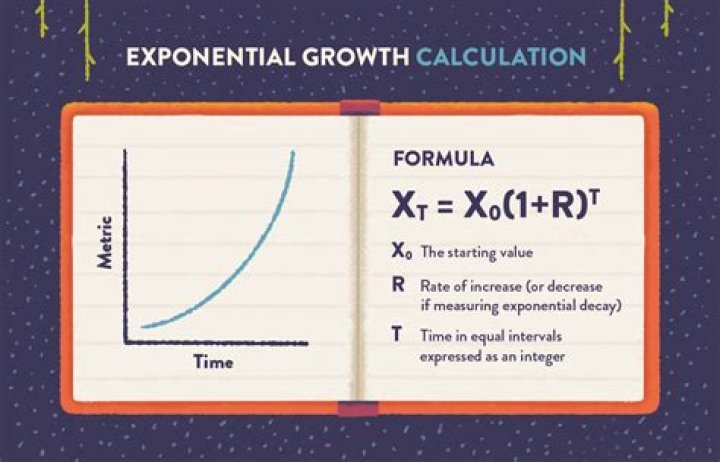
Exponential functions are patterns that get continuously multiplied by some number. It’s exponential growth when the base of our exponential is bigger than 1, which means those numbers get bigger. It’s exponential decay when the base of our exponential is in between 1 and 0 and those numbers get smaller.
What are examples of exponential functions?
An example of an exponential function is the growth of bacteria. Some bacteria double every hour. If you start with 1 bacterium and it doubles every hour, you will have 2x bacteria after x hours. This can be written as f(x) = 2x.
How are exponential functions used in real life?
Exponential functions are often used to represent real-world applications, such as bacterial growth/decay, population growth/decline, and compound interest. Suppose you are studying the effects of an antibiotic on a certain bacteria. Every 15 minutes, you check the petri dish and count the number of bacteria present.
What is an example of exponential function?
Exponential functions have the form f(x) = bx, where b > 0 and b ≠ 1. An example of an exponential function is the growth of bacteria. Some bacteria double every hour. If you start with 1 bacterium and it doubles every hour, you will have 2x bacteria after x hours. This can be written as f(x) = 2x.
What is the rule for an exponential function?
An exponential function is a Mathematical function in form f (x) = ax, where “x” is a variable and “a” is a constant which is called the base of the function and it should be greater than 0. The most commonly used exponential function base is the transcendental number e, which is approximately equal to 2.71828.
How to evaluate an exponential function other than the basic form?
To evaluate an exponential function with a form other than the basic form, it is important to follow the order of operations. For example: Note that if the order of operations were not followed, the result would be incorrect:
Which is the correct formula for exponential decay?
Showing that N (t)=Ne^ (-kt) describes the amount of a radioactive substance we have at time T. For students with background in Calculus. Not necessary for intro chemistry class.
How to calculate the decay constant of radioactive decay?
To measure the decay constant, we take a sample of known mass and measure the number of radioactive decays per second as a function of time. Then we do a little bit of math to get the decay constant. Comment on Just Keith’s post “We measure the decay constant, which can be done i…”
What makes an exponential function not a power function?
By definition, an exponential function has a constant as a base and an independent variable as an exponent. Thus, does not represent an exponential function because the base is an independent variable. In fact, is a power function.